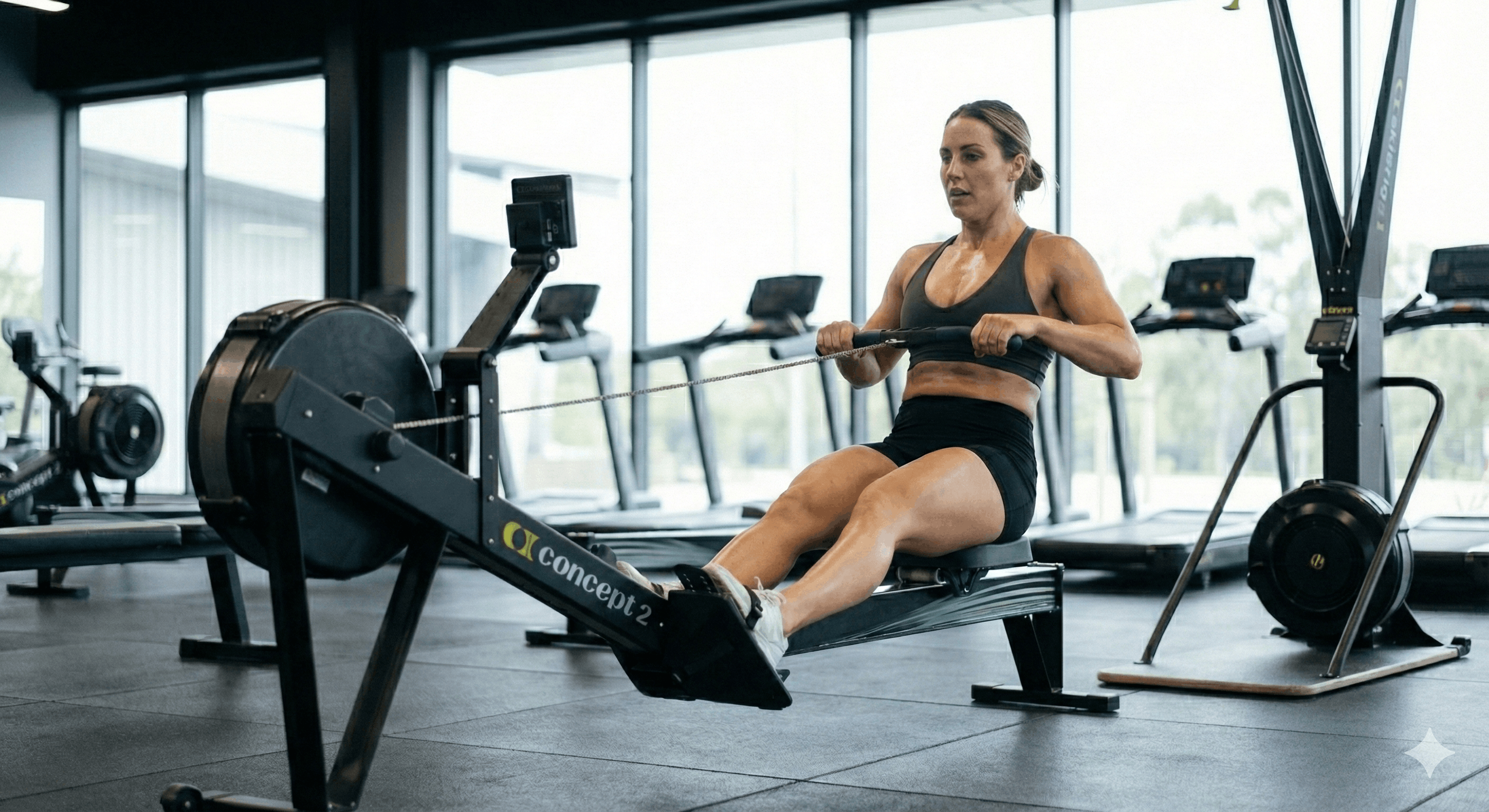
HYROX Rowing Strategy: How to Pace 1000m and Recover for the Second Half
After four stations and five kilometers of running, you finally get to sit down. The Concept2 rower at Station 5 is both a blessing and a trap.
Here's the trap: athletes see sitting and think "recovery." They take it easy, row at 2:30/500m pace, and waste 5+ minutes getting nowhere. Or they do the opposite—sprint at 1:40/500m pace because they finally feel okay, only to implode during the farmer's carry.
1000 meters of rowing demands strategy. Done right, it's active recovery that doesn't cost you time. Done wrong, it's a momentum killer or an energy burner that haunts you for the final three stations.
In this guide, you'll learn how to row efficiently, pace strategically, and use Station 5 as a tactical advantage instead of a liability.
What is the Rowing Station in HYROX?
The rowing station is Station 5 in HYROX—the first station of the race's second half. After your fifth 1km run (following burpee broad jumps), you complete 1000 meters on the Concept2 rowing machine.
Race Standards:
- Distance: 1000 meters
- Machine: Concept2 RowErg (Damper setting at athlete discretion)
- Position in Race: Station 5 (after fifth 1km run)
- Average Completion Time: 3:30-5:00 (depending on fitness and pacing strategy)
Strategic Position: The row comes at the race's midpoint when fatigue is highest. It's also the last "seated" station—everything after requires standing and loaded movement.
Rowing Muscles Worked: The Full-Body Engine
The rowing stroke is 85% legs, 10% core, and 5% arms. Most people get this ratio completely wrong.
Primary Muscles
- Quadriceps: Drive the initial push phase—the most powerful part of the stroke.
- Glutes: Extend the hips during the drive.
- Latissimus Dorsi: Pull the handle during the finish phase.
- Hamstrings: Assist in the drive and control the recovery.
Secondary Muscles
- Core (Rectus Abdominis, Obliques): Transfers power from legs to arms and maintains posture.
- Biceps: Assist in the pulling motion.
- Forearms: Control handle grip throughout the stroke.
- Calves: Push off the foot stretchers.
- Erector Spinae: Maintains spine stability during the layback.
The Leg Drive Advantage
- Key Insight: Elite rowers generate 70% of their power from legs, not arms. In HYROX, your arms are already fatigued from SkiErg, sled pull, and burpees. Leg drive is your advantage. Use it.
Perfect Rowing Technique: The HYROX-Optimized Stroke
Rowing efficiency matters more than raw power. Here's the stroke breakdown:
The Catch (Start Position)
- Shins vertical, knees bent
- Arms extended, shoulders forward
- Core engaged, back straight
- Grip relaxed—hooks, not death grip
The Drive (Power Phase)
- Push with your legs first—the handle doesn't move until your legs extend
- Once legs are almost straight, lean back slightly (to 1 o'clock position)
- Pull handle to lower chest as the final motion
- Sequence: Legs → Back → Arms (always in that order)
The Finish
- Legs straight
- Slight layback
- Handle at lower chest/upper stomach
- Brief pause—don't rush the recovery
The Recovery (Return to Catch)
- Arms extend first
- Body rocks forward
- Legs bend last as you slide back to the catch
- Recovery should take twice as long as the drive
- Sequence: Arms → Back → Legs (reverse of drive)
Stroke Rate for HYROX
- Target: 24-28 strokes per minute for most athletes
- Too slow (under 22): You're leaving time on the table
- Too fast (over 32): You're probably getting sloppy and wasting energy
Common Rowing Mistakes (And How to Fix Them)
Mistake #1: Arms Before Legs
The Problem: Pulling with your arms before your legs extend, losing power.
The Fix: Drill it: "Legs. Back. Arms." Say it out loud during training. The handle shouldn't bend until your legs are almost straight.
Mistake #2: Hunching Forward
The Problem: Rounding your back at the catch, straining your lower back.
The Fix: Keep your chest proud throughout the stroke. Engage your lats at the catch to maintain posture.
Mistake #3: Rushing the Recovery
The Problem: Sliding back to the catch at the same speed as the drive, creating jerky strokes.
The Fix: The recovery is controlled rest. Slow slide forward, explosive drive back. 2:1 ratio.
Mistake #4: Damper Setting Too High
The Problem: Setting the damper to 10 thinking it makes you faster. It doesn't.
The Fix: Set damper between 4-6 for most athletes. It's not a resistance machine—it controls airflow. Higher settings fatigue your muscles faster without improving speed.
Mistake #5: Pulling to Your Chin
The Problem: Finishing with the handle at neck level, straining arms and shoulders.
The Fix: Handle finishes at lower chest or upper stomach. Elbows should pull straight back, not up.
Mistake #6: Death Grip on the Handle
The Problem: Squeezing the handle like it owes you money, frying already-fatigued forearms.
The Fix: Loose hook grip. Fingers over the handle, relaxed grip. Your back does the pulling, not your hands.
HYROX Rowing Pacing Strategy
The 1000m row is a strategic puzzle. Here's how to solve it:
Option 1: Conservative "Recovery" Pace
Best For: Athletes who struggled in the first half and need to regroup.
Splits:
- 0-250m: 2:05-2:10/500m
- 250-500m: 2:05-2:10/500m
- 500-750m: 2:00-2:05/500m
- 750-1000m: 1:55-2:00/500m
Total Time: ~4:00-4:15 Benefit: Lowers heart rate, catches breath, preserves legs for farmer's carry.
Option 2: Steady State "Time Saver" Pace
Best For: Athletes who are racing for time and feeling okay.
Splits:
- 0-250m: 1:55-2:00/500m
- 250-500m: 1:50-1:55/500m
- 500-750m: 1:50-1:55/500m
- 750-1000m: 1:45-1:50/500m
Total Time: ~3:40-3:50 Benefit: Solid time without burning out.
Option 3: Aggressive "Send It" Pace
Best For: Elite athletes who can recover on the run.
Splits:
- 0-250m: 1:45-1:50/500m
- 250-500m: 1:42-1:47/500m
- 500-750m: 1:42-1:47/500m
- 750-1000m: 1:40-1:45/500m
Total Time: ~3:20-3:30 Benefit: Maximum time savings, but requires fitness to recover.
The Golden Rule
Negative split your row. Start conservative, finish fast. A 2:00 first 500m and 1:45 second 500m is better than blowing up at 1:40 and crawling to a 2:10 finish.
Rowing Alternatives for Training
Not everyone has a Concept2 rower at home. Here are alternatives that build rowing fitness:
1. Dumbbell Rows (High Rep)
- Why It Works: Builds back endurance and mimics the pulling pattern
- Protocol: 4 sets of 20-25 reps each arm
2. Resistance Band Rows
- Why It Works: Low-impact back and core work
- Protocol: 100 reps for time with medium band
3. Bent-Over Barbell Rows
- Why It Works: Develops back strength and core stability
- Protocol: 3 sets of 15 at moderate weight
4. Good Mornings
- Why It Works: Strengthens the posterior chain used in the rowing drive
- Protocol: 3 sets of 12
5. Kettlebell Swings
- Why It Works: Hip drive power that transfers to leg drive in rowing
- Protocol: 5 rounds of 20 swings
6. Bike Erg or Assault Bike
- Why It Works: Similar aerobic demand with seated position
- Protocol: 3km bike for time
7. Deadlifts + Pull-Ups (Superset)
- Why It Works: Combines the hip hinge and pulling patterns
- Protocol: 5 rounds: 8 Deadlifts + 10 Pull-Ups
Rowing Training Workouts for HYROX
Workout 1: Pacing Practice
- 4 x 500m Row
- Rest 2 minutes between
- Goal: Negative split each 500m AND the overall set
Workout 2: Race Simulation (Stations 4-6)
- 1km Run
- 80m Burpee Broad Jumps
- 1km Run
- 1000m Row
- 1km Run
- 200m Farmer's Carry
- Track all splits
Workout 3: Endurance Builder
- 3000m Row
- Every 500m: Get off and do 10 push-ups
- Goal: Maintain consistent split despite interruptions
Workout 4: Interval Power
- 8 x 250m Row
- Rest 1:00 between
- Goal: Hold target split across all 8 pieces
Workout 5: Leg Drive Focus
- 5 x 500m Row
- Stroke rate cap: 22 SPM
- Goal: Hit fast splits with slow strokes (forces leg drive efficiency)
The Strategic Advantage: Row to Recover
Here's the HYROX secret: the row is the only station where you sit down. Smart athletes use this strategically.
What Recovery Looks Like:
- Controlled breathing returns
- Heart rate drops 10-15 BPM
- Legs get brief relief from impact
- Mental reset before the final push
What Recovery Does NOT Look Like:
- Going so easy you waste 5+ minutes
- Stopping mid-row to catch your breath
- Ignoring technique and letting form fall apart
The row should feel like you're working but sustainable. If you can't talk in short sentences, you're going too hard. If you could read a book, you're going too easy.
Train Like You Race
Here's the problem: most people train rowing fresh. They hop on the Concept2 with rested legs and pull a great 1000m time. Then race day comes, and they're rowing after burpee broad jumps with legs full of lead.
OnlyGains.ai fixes this disconnect. The platform creates unlimited free HYROX simulations that put rowing where it belongs—after stations 1-4, with accumulated fatigue. You train the row in context, not in isolation.
When you know what 1000m feels like after 5km of running and 4 brutal stations, you can pace race day confidently. No surprises, no blow-ups, just smart execution.
Rowing Benchmarks: Where Do You Stand?
| Level | 1000m Time | Pace/500m |
|---|---|---|
| Elite | Under 3:10 | Under 1:35 |
| Advanced | 3:10-3:40 | 1:35-1:50 |
| Intermediate | 3:40-4:15 | 1:50-2:07 |
| Beginner | 4:15-5:00 | 2:07-2:30 |
| First-Timer | 5:00+ | 2:30+ |
Note: These times are for fresh rowing. Expect 10-20% slower in a HYROX race due to fatigue.
Mental Game: The Halfway Turning Point
Station 5 is psychologically critical. You're done with the hardest station (burpees), but you've still got three loaded carries and three runs ahead.
Winning the mental game:
- Celebrate the midpoint: You're halfway done. Acknowledge the accomplishment.
- Enjoy the seat: Seriously—this is the only time you get to sit. Appreciate it.
- Visualize success: During the row, picture yourself finishing strong at wall balls.
- Trust your pacing: Don't panic if you're not the fastest rower. Stick to your plan.
Final Thoughts: Row Smart, Finish Strong
The rowing station separates athletes who race strategically from those who wing it. It's not about being the fastest rower—it's about using the row to set up a strong finish.
Key Takeaways:
- Legs drive the stroke—not arms
- Pace conservatively—negative split your row
- Use it for recovery—lower heart rate and breathe
- Don't waste it—5-minute rows cost you podium spots
- Train in context—row fatigued, not fresh
The athletes who crush HYROX treat the row as tactical recovery. They come off the rower ready for farmer's carries, not gasping for survival.
Ready to build your race strategy? OnlyGains.ai generates personalized HYROX training programs that teach you how to row under fatigue. Unlimited free simulations mean you can practice race pacing without guessing.