What is HYROX? The Complete Guide to the World's Toughest Fitness Race
If you've seen people on social media pushing sleds, rowing furiously, and doing endless wall balls—all while looking completely destroyed—you've probably seen HYROX.
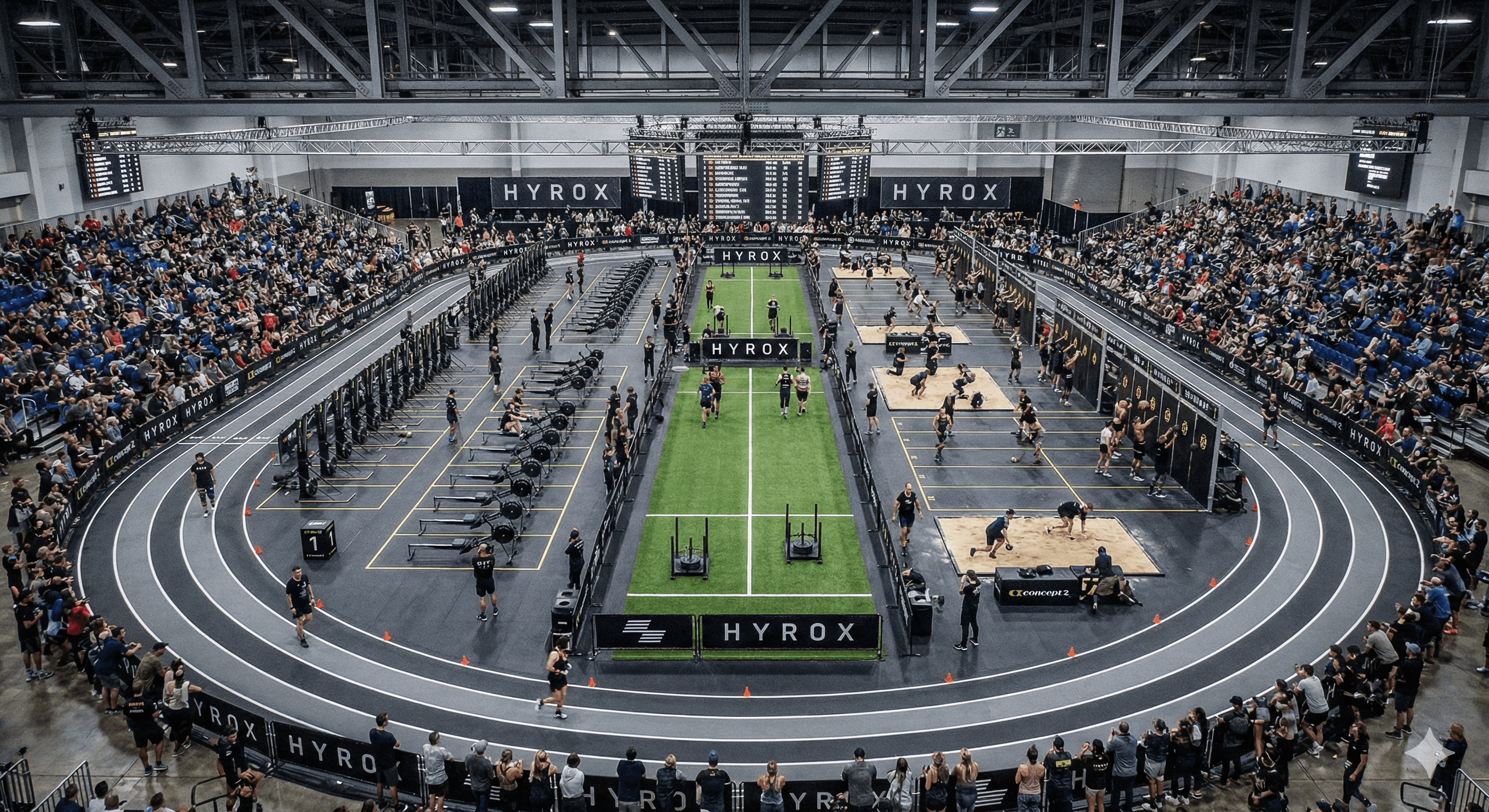
HYROX is the World Series of Fitness Racing. It's a standardized indoor competition that combines running with functional strength exercises. Think of it as a triathlon for the gym crowd—except instead of swimming and cycling, you're doing SkiErg, sled pushes, and burpee broad jumps.
Since its founding in 2017, HYROX has exploded from a niche German competition to a global phenomenon with events on six continents. In 2024 alone, over 100,000 athletes competed in HYROX races worldwide.
This guide covers everything: the race format, every station explained, world records, past champions, divisions, and how to get started.
The HYROX Race Format: 8 Stations, 8 Runs, 1 Finish Line
Every HYROX race follows the exact same format. It doesn't matter if you're racing in Munich, Miami, or Melbourne—the structure is identical.
The Formula:
- 1km Run → Station → 1km Run → Station → Repeat 8 times
- Total Running: 8 kilometers
- Total Stations: 8 functional exercises
The Order (Never Changes):
- 1km Run → SkiErg (1000m)
- 1km Run → Sled Push (50m)
- 1km Run → Sled Pull (50m)
- 1km Run → Burpee Broad Jumps (80m)
- 1km Run → Rowing (1000m)
- 1km Run → Farmers Carry (200m)
- 1km Run → Sandbag Lunges (100m)
- 1km Run → Wall Balls (100 reps)
The beauty of HYROX is its standardization. Unlike CrossFit competitions where workouts change constantly, HYROX is always the same. You can train specifically for it, benchmark your progress, and compare your times to anyone in the world.
All 8 HYROX Stations Explained
Station 1: SkiErg (1000m)
The race opener. After your first 1km run, you hit the SkiErg for 1000 meters of simulated cross-country skiing.
What It Tests: Upper body pulling endurance, core stability, cardiovascular capacity Common Mistake: Starting too fast and frying your arms before the sled work Elite Time: Under 3:30 Average Time: 4:00-5:30
Station 2: Sled Push (50m)
Your first taste of heavy leg work. Push a loaded sled 50 meters as fast as possible.
Weights:
- Pro Men: 152kg (335lbs)
- Pro Women: 102kg (225lbs)
- Open Men: 102kg (225lbs)
- Open Women: 102kg (225lbs)
What It Tests: Quad strength, mental toughness, anaerobic power Common Mistake: Standing too upright instead of driving with low body position Elite Time: Under 1:00 Average Time: 1:30-3:00
Station 3: Sled Pull (50m)
Immediately following the push, you now pull a loaded sled 50 meters toward you using a rope.
Weights: Same as sled push
What It Tests: Grip strength, back strength, hip drive coordination Common Mistake: Using only arms instead of legs and hips Elite Time: Under 1:30 Average Time: 2:00-4:00
Station 4: Burpee Broad Jumps (80m)
The race-breaker. 80 meters of burpee broad jumps—approximately 25-40 reps depending on your jump distance.
What It Tests: Full-body conditioning, explosive power, mental resilience Common Mistake: Jumping up instead of forward (more jumps = more time) Elite Time: Under 2:30 Average Time: 3:30-6:00
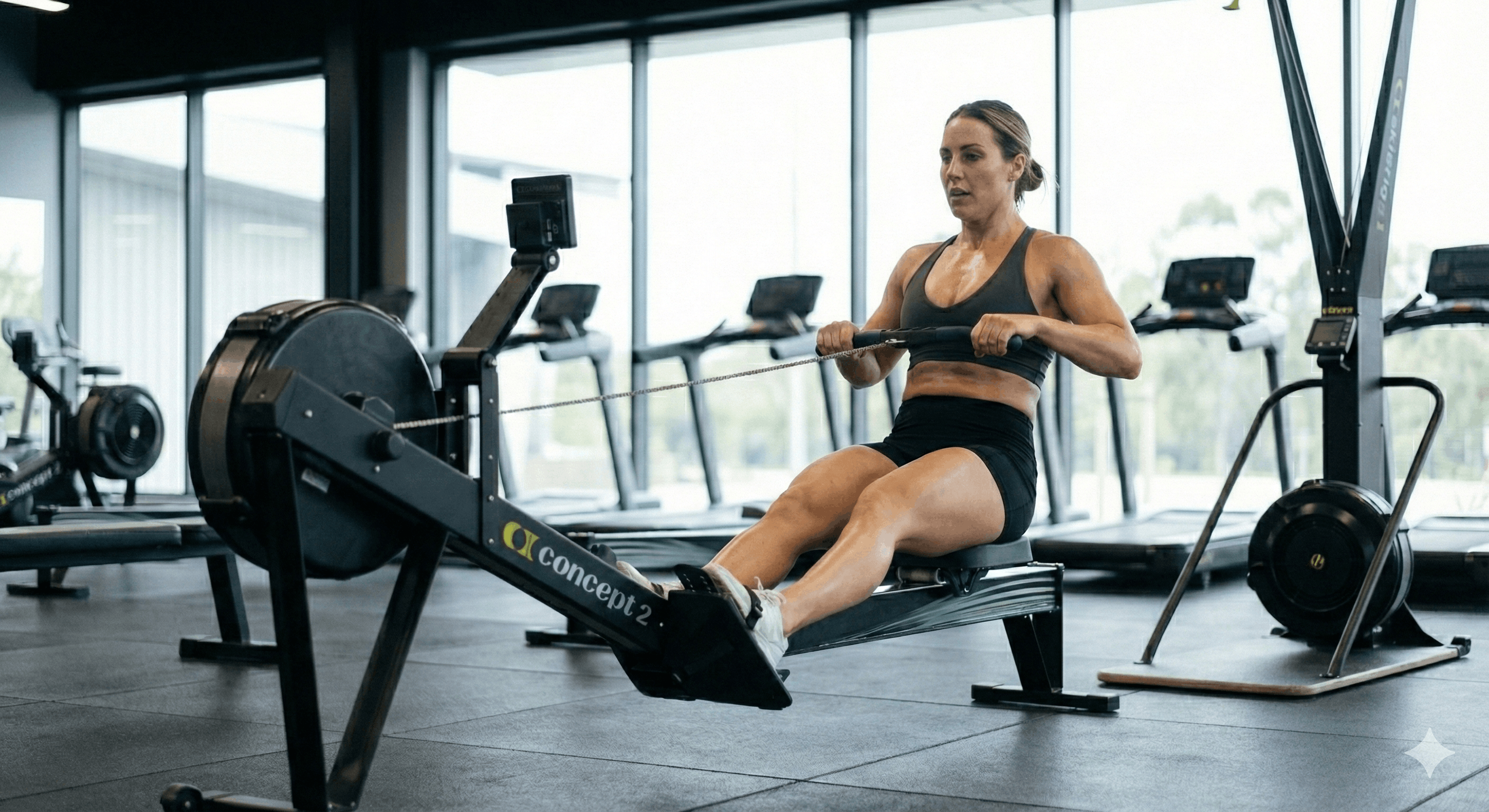
Station 5: Rowing (1000m)
A chance to sit down—but don't get comfortable. 1000 meters on the Concept2 rower is a brutal test of leg and back endurance.
What It Tests: Leg drive power, aerobic capacity, pacing discipline Common Mistake: Going out too fast and blowing up at 600m Elite Time: Under 3:20 Average Time: 3:45-5:00
Station 6: Farmers Carry (200m)
Carry heavy kettlebells for 200 meters. Sounds simple. It's not.
Weights:
- Pro Men: 2 x 32kg (70lbs each)
- Pro Women: 2 x 24kg (53lbs each)
- Open Men: 2 x 24kg (53lbs each)
- Open Women: 2 x 16kg (35lbs each)
What It Tests: Grip endurance, core stability, mental persistence Common Mistake: Setting down the weights too often (each drop costs time) Elite Time: Under 1:30 Average Time: 2:00-4:00
Station 7: Sandbag Lunges (100m)
100 meters of walking lunges with a sandbag on your shoulders. Your quads will hate you.
Weights:
- Pro Men: 30kg (66lbs)
- Pro Women: 20kg (44lbs)
- Open Men: 20kg (44lbs)
- Open Women: 10kg (22lbs)
What It Tests: Single-leg strength, quad endurance, balance under fatigue Common Mistake: Taking steps that are too long (burns out faster) Elite Time: Under 2:00 Average Time: 3:00-5:00
Station 8: Wall Balls (100 Reps)
The final station. 100 wall balls stand between you and the finish line.
Weights & Targets:
- Pro Men: 9kg ball to 3m target
- Pro Women: 6kg ball to 2.7m target
- Open Men: 6kg ball to 2.7m target
- Open Women: 4kg ball to 2.7m target
What It Tests: Full-body endurance, mental fortitude, the will to finish Common Mistake: Breaking too often instead of pushing through Elite Time: Under 4:00 Average Time: 5:00-8:00
HYROX Divisions: Finding Your Category
HYROX offers multiple divisions to match every fitness level:
Individual Divisions
Pro Division:
- Heaviest weights
- For competitive athletes
- World Championship qualification
Open Division:
- Lighter weights than Pro
- For experienced recreational athletes
- Most popular division
Doubles Division:
- Two athletes, alternating stations
- Each athlete completes half the work
- Great for friends/couples
Age Group Divisions
- 16-24, 25-29, 30-34, 35-39, 40-44, 45-49, 50-54, 55-59, 60+
- Compete against your age bracket
- Same weights as your gender's division
Relay Division
- 4-person teams
- Each athlete completes 2 runs + 2 stations
- Great for corporate teams or friends
HYROX World Records and Notable Times
Men's World Records
| Record | Athlete | Time | Event |
|---|---|---|---|
| Pro World Record | Hunter McIntyre (USA) | 53:36 | 2022 HYROX World Championships |
| Open Record | Various | ~58:00 | Multiple events |
Women's World Records
| Record | Athlete | Time | Event |
|---|---|---|---|
| Pro World Record | Lauren Weeks (USA) | 58:17 | 2023 HYROX World Championships |
| Open Record | Various | ~65:00 | Multiple events |
Doubles World Records
| Category | Athletes | Time |
|---|---|---|
| Pro Mixed | Various elite pairings | ~48:00 |
| Pro Male | Various elite pairings | ~45:00 |
| Pro Female | Various elite pairings | ~52:00 |
Note: Records are frequently broken as the sport grows. Check HYROX official channels for current records.
Past HYROX World Champions
Men's Pro Champions
| Year | Champion | Nationality | Time |
|---|---|---|---|
| 2023 | Hunter McIntyre | USA | 54:21 |
| 2022 | Hunter McIntyre | USA | 53:36 |
| 2021 | Hunter McIntyre | USA | 57:09 |
| 2020 | (Cancelled - COVID) | - | - |
| 2019 | Christian Toetzke | Germany | 1:02:38 |
Women's Pro Champions
| Year | Champion | Nationality | Time |
|---|---|---|---|
| 2023 | Lauren Weeks | USA | 58:17 |
| 2022 | Lauren Weeks | USA | 1:00:15 |
| 2021 | Molly Marsch | USA | 1:03:34 |
| 2020 | (Cancelled - COVID) | - | - |
| 2019 | Angelique Du Toit | South Africa | 1:14:27 |
The Dominant Names:
- Hunter McIntyre: The face of men's HYROX. Former obstacle course racer who has dominated since entering the sport.
- Lauren Weeks: Revolutionized women's HYROX with sub-60 minute times.
What Makes a Good HYROX Time?
General Benchmarks
| Level | Men's Time | Women's Time |
|---|---|---|
| Elite Pro | Under 1:00:00 | Under 1:10:00 |
| Competitive | 1:00:00-1:15:00 | 1:10:00-1:25:00 |
| Strong Amateur | 1:15:00-1:30:00 | 1:25:00-1:40:00 |
| Fit Recreational | 1:30:00-1:45:00 | 1:40:00-1:55:00 |
| Beginner/First Race | 1:45:00-2:00:00 | 1:55:00-2:15:00 |
| Completion Goal | 2:00:00+ | 2:15:00+ |
Reality Check: Sub-90-minute times require dedicated training. If it's your first HYROX, aim to finish strong, not fast.
The History of HYROX
2017: The Beginning
- Founded in Hamburg, Germany by Christian Toetzke and Moritz Fürste
- First event held with just a few hundred participants
- Concept: Create a fitness race with standardized format anyone could train for
2018-2019: European Expansion
- Events spread across Germany, UK, and other European countries
- Participation grows to thousands per event
- Professional division established
2020: COVID Pivot
- World Championship cancelled
- Virtual HYROX @Home launched
- Sport maintains momentum despite global shutdown
2021-2022: Global Explosion
- Events launch in USA, Asia, Middle East, Australia
- Hunter McIntyre breaks 54-minute barrier
- Participation exceeds 50,000 annually
2023-2024: Mainstream Recognition
- Over 100,000 participants annually
- Events in 30+ countries
- Major sponsorship deals and media coverage
- HYROX World Championships become premier fitness event
2025 and Beyond
- Continued expansion into new markets
- Growing prize purses for professional athletes
- Potential Olympic sport discussions (long-term)
How to Start Training for HYROX
The Pillars of HYROX Fitness
1. Running Capacity
- You must be able to run 8km at race pace
- Build to 30-40km weekly running volume
- Practice running under fatigue (after strength work)
2. Functional Strength
- Squat, push, pull, hinge, carry
- Focus on strength-endurance (high rep ranges)
- Train the specific movements: sled work, SkiErg, rowing
3. Station-Specific Skills
- Wall ball technique matters more than wall ball strength
- Burpee broad jump efficiency saves minutes
- Sled push positioning determines speed
4. Transitions
- Practice moving from station to running immediately
- Minimize rest between efforts
- Mental preparation for continuous effort
Sample Training Week (Intermediate)
| Day | Session |
|---|---|
| Monday | Running: 5 x 1km intervals + core work |
| Tuesday | Strength: Lower body emphasis + SkiErg intervals |
| Wednesday | Easy run: 6-8km recovery pace |
| Thursday | Strength: Upper body + rowing intervals |
| Friday | Active recovery or rest |
| Saturday | HYROX Simulation: Partial or full race rehearsal |
| Sunday | Long run: 10-12km at conversational pace |
Training for HYROX Without the Guesswork
Here's the challenge: HYROX requires training eight completely different stations plus running. Most people don't know how to program all of that effectively.
OnlyGains.ai solves this problem. The platform creates HYROX-specific simulations that sequence running with functional movements exactly like race day. No generic CrossFit workouts—actual HYROX preparation.
The AI adapts to your equipment availability. Don't have sleds? You'll get appropriate substitutions. Have full HYROX gear? You'll train the real thing. Every session builds toward race-ready fitness.
Whether you're training for your first HYROX or chasing a PR, intelligent programming beats random workouts every time.
Common HYROX Beginner Mistakes
Mistake #1: Only Training Stations, Ignoring Running
Reality: Running is 50%+ of your race time. Train it accordingly.
Mistake #2: Training Fresh, Racing Fatigued
Reality: You never hit a station fresh in HYROX. Always train movements after running or other exercises.
Mistake #3: Going Out Too Fast
Reality: HYROX is a 60-90+ minute effort. Run 1 sets the tone—don't blow up early.
Mistake #4: Ignoring Transitions
Reality: Elite athletes lose 5-10 seconds per transition. Beginners lose 30-45. That's 4+ minutes of free time over 8 stations.
Mistake #5: Not Practicing the Full Race
Reality: You need at least 2-3 full simulations before race day. The cumulative fatigue is different from training individual stations.
HYROX Equipment: What You Actually Need
Must-Have for Training
- Running shoes (worn-in, comfortable for 8km+)
- Access to rowing machine (Concept2 preferred)
- Dumbbells or kettlebells for farmers carry simulation
- Medicine ball for wall balls
- Space for burpee broad jumps
Nice-to-Have
- SkiErg (expensive, but irreplaceable)
- Sled and weights
- Sandbag for lunges
- HYROX-specific gym membership (growing in popularity)
Alternatives That Work
- SkiErg → Battle ropes, dumbbell pull-overs
- Sled push/pull → Weighted walks, prowler alternatives
- Sandbag → Heavy backpack, barbell lunges
Race Day Tips for First-Timers
Before the Race
- Arrive 90+ minutes early—registration, warm-up, and finding your wave
- Eat 2-3 hours before—nothing new, stick to familiar foods
- Warm up properly—light jog, dynamic stretches, a few burpees
- Use the bathroom before your wave—no port-a-potty breaks mid-race
During the Race
- Start conservatively—especially Run 1 and Station 1
- Hydrate at rowing and SkiErg stations—quick sips only
- Don't stop moving—walk if you must, but keep moving forward
- Use the crowd—HYROX events are loud and energetic, feed off it
After the Race
- Keep walking—don't sit down immediately
- Hydrate and eat—your body needs fuel
- Celebrate—you just finished one of the toughest fitness challenges in the world
Is HYROX Right for You?
HYROX is for you if:
- ✅ You enjoy both running and strength training
- ✅ You want a competitive but achievable fitness goal
- ✅ You like measurable progress (standardized format)
- ✅ You thrive in race environments
- ✅ You want to join a global fitness community
HYROX might not be for you if:
- ❌ You hate running
- ❌ You're looking for a pure strength competition
- ❌ You don't enjoy endurance efforts
- ❌ You prefer training alone without competitive goals
Final Thoughts: The Fitness Race for Everyone
HYROX has democratized fitness racing. You don't need elite genetics, decade-long training backgrounds, or specialized skills. You need work capacity, smart training, and the willingness to suffer for 60-120 minutes.
The standardized format means anyone can compete. The global community means you're never alone. And the personal challenge means every finish line—whether at 55 minutes or 2 hours—is an achievement.
Key Takeaways:
- HYROX is simple: 8 runs + 8 stations = 1 race
- The stations are trainable: SkiErg, sleds, rowing, lunges, wall balls—all improvable with practice
- Running matters most: It's half the race
- Start slow, finish strong: Pacing beats fitness in HYROX
- Anyone can do it: From first-timers to world champions, same race, same format
Ready to start training? OnlyGains.ai creates unlimited HYROX simulations tailored to your fitness level and available equipment. Stop guessing what to train and start preparing for the race that's taking over the fitness world.
See you at the start line. 🏁